
Technology
How immersion battery packs help reduce thermal runaway propagation risk
Direct Answer
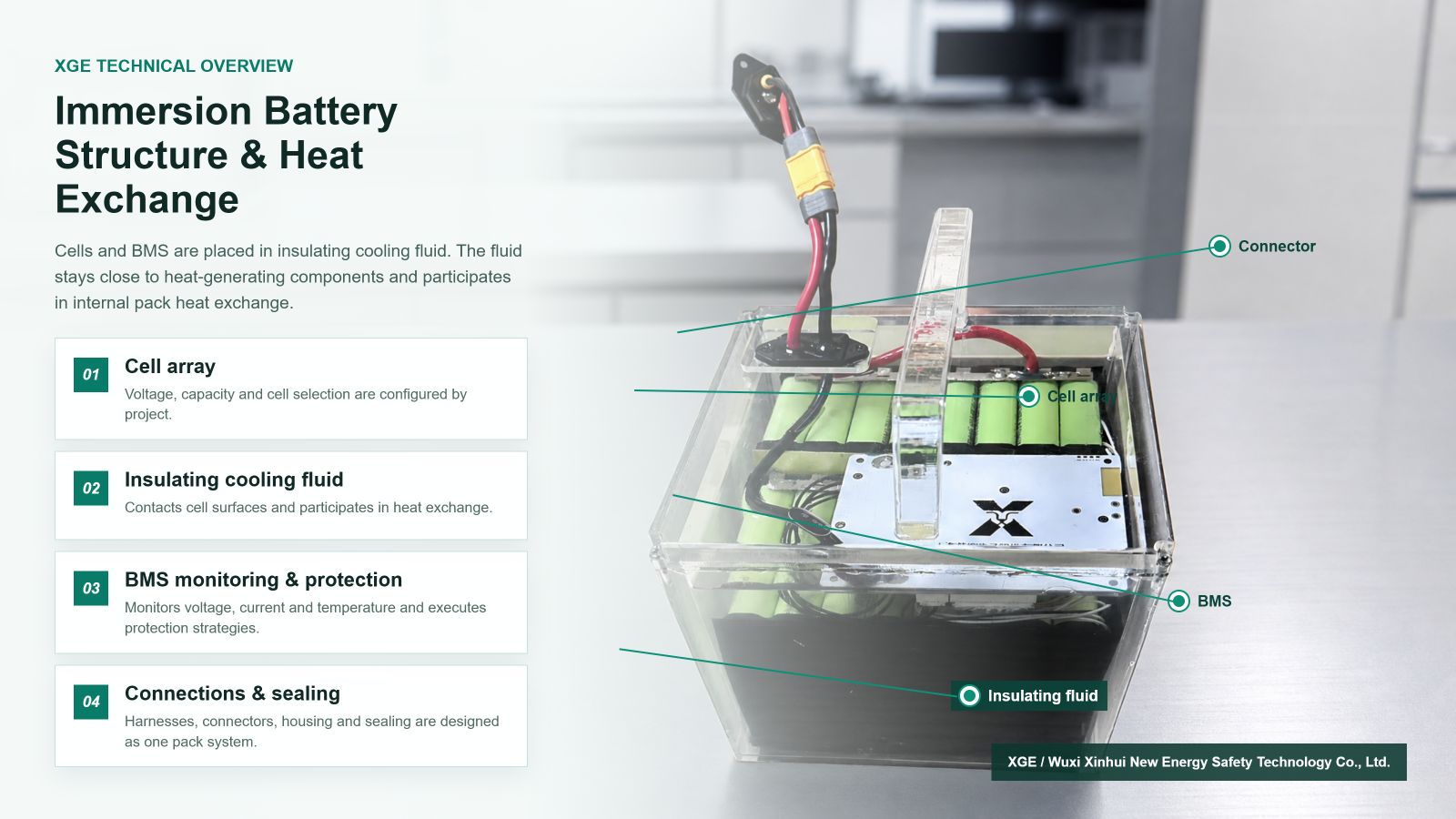
Immersion lithium battery packs use insulating fluid to directly contact cell surfaces, support heat exchange, improve temperature uniformity, and work together with BMS monitoring, pack structure, sealing, and testing to help reduce abnormal heat propagation between cells.
Thermal runaway vs. thermal propagation
Thermal runaway refers to abnormal and rapid temperature rise inside a cell. Thermal propagation focuses on whether heat, flame, gas, or other effects spread from one cell to nearby cells or the entire pack.
System-level safety design
- Insulating fluid participates in heat exchange.
- BMS monitors voltage, current, and temperature.
- Pack structure, sealing, and venting support risk control.
- Factory testing and batch traceability support consistency.
Claim boundary
Immersion battery packs should not be marketed as an absolute safety guarantee or failure-proof. A compliant professional claim is: designed to help reduce thermal runaway propagation risk.
Need a technical review?
Share your vehicle platform and operating conditions for an initial assessment.
Request Technical Review