Thermal propagation risk
An abnormal cell may transfer heat to nearby cells. Pack-level design helps slow down risk escalation.
 Xinhui Green EnergyXGE Immersion Battery
Get a Proposal
Xinhui Green EnergyXGE Immersion Battery
Get a Proposal
Wuxi Xinhui New Energy Safety Technology Co., Ltd.
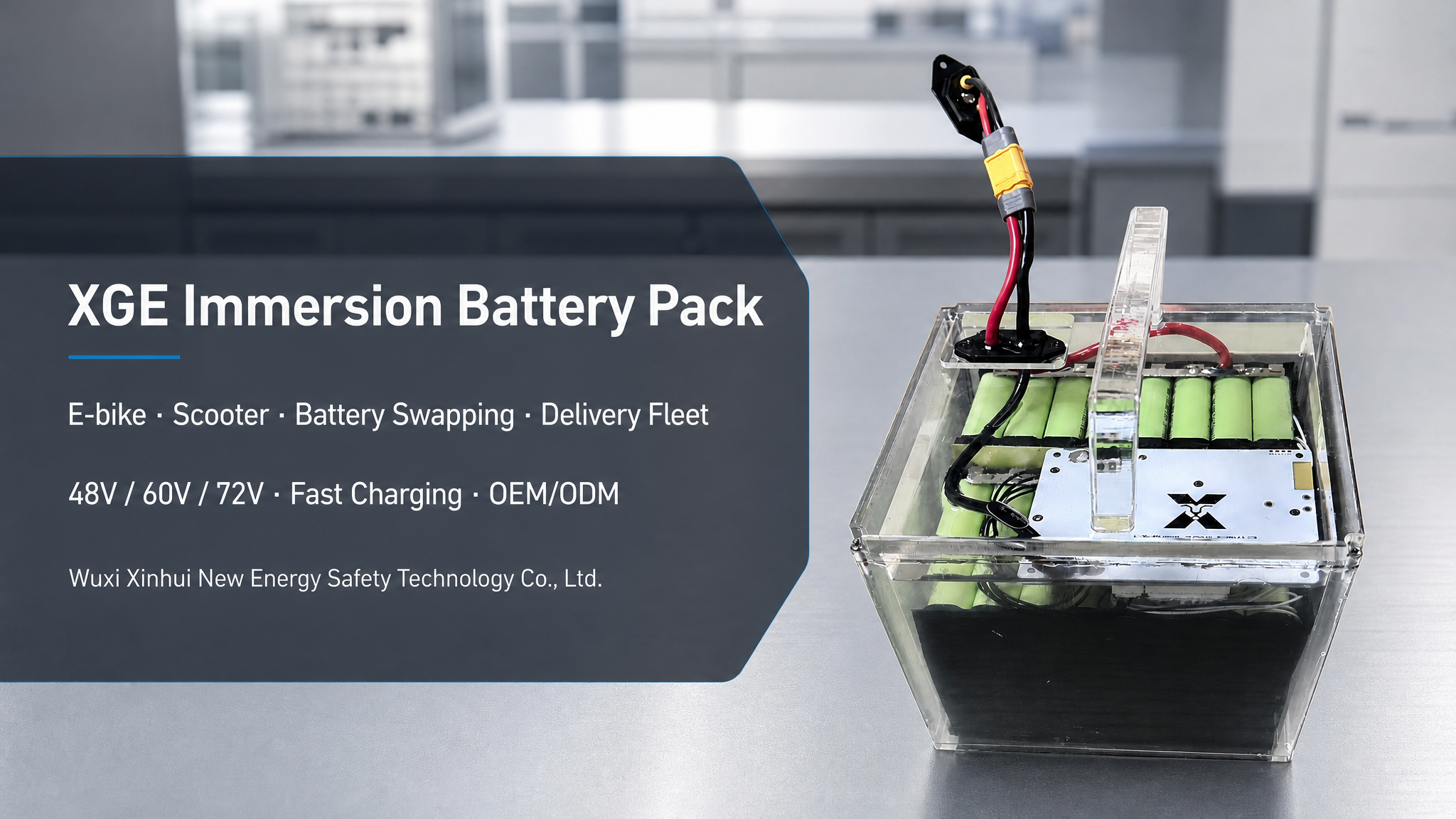
Xinhui Green Energy develops immersion safety lithium battery packs for electric two-wheelers, tricycles, battery swapping, delivery fleets, distributors, and OEM/ODM programs. The battery cells and BMS are immersed in biodegradable insulating cooling fluid to improve thermal-management redundancy and help reduce thermal propagation risk. Programs cover 48V/60V/72V, 1C fast charging, 3C ultra-fast charging, and custom capacity and pack structures, subject to project validation.
Why it matters
For high-temperature markets, frequent charging, centralized battery swapping, delivery fleets, and long operating hours, battery buyers need more than nominal capacity. They need thermal management, BMS protection, pack structure, certification documents, and traceable production consistency.
An abnormal cell may transfer heat to nearby cells. Pack-level design helps slow down risk escalation.
Battery swapping and delivery fleets require frequent charging, reliable tracking, and consistent maintenance.
Importers, OEMs, and distributors need clear model scope, certificates, specifications, and shipment documents.
Technology
Instead of relying only on air cooling or indirect heat transfer, the battery cells are placed in an insulating fluid environment. The fluid directly contacts the cell surface and participates in heat exchange, helping reduce local hot spots and improve temperature uniformity.
No battery technology should be described as an absolute safety guarantee or failure-proof. A professional claim is: designed to help reduce thermal runaway propagation risk when combined with cell quality, BMS strategy, pack structure, testing, and proper use.
Explore the technical principle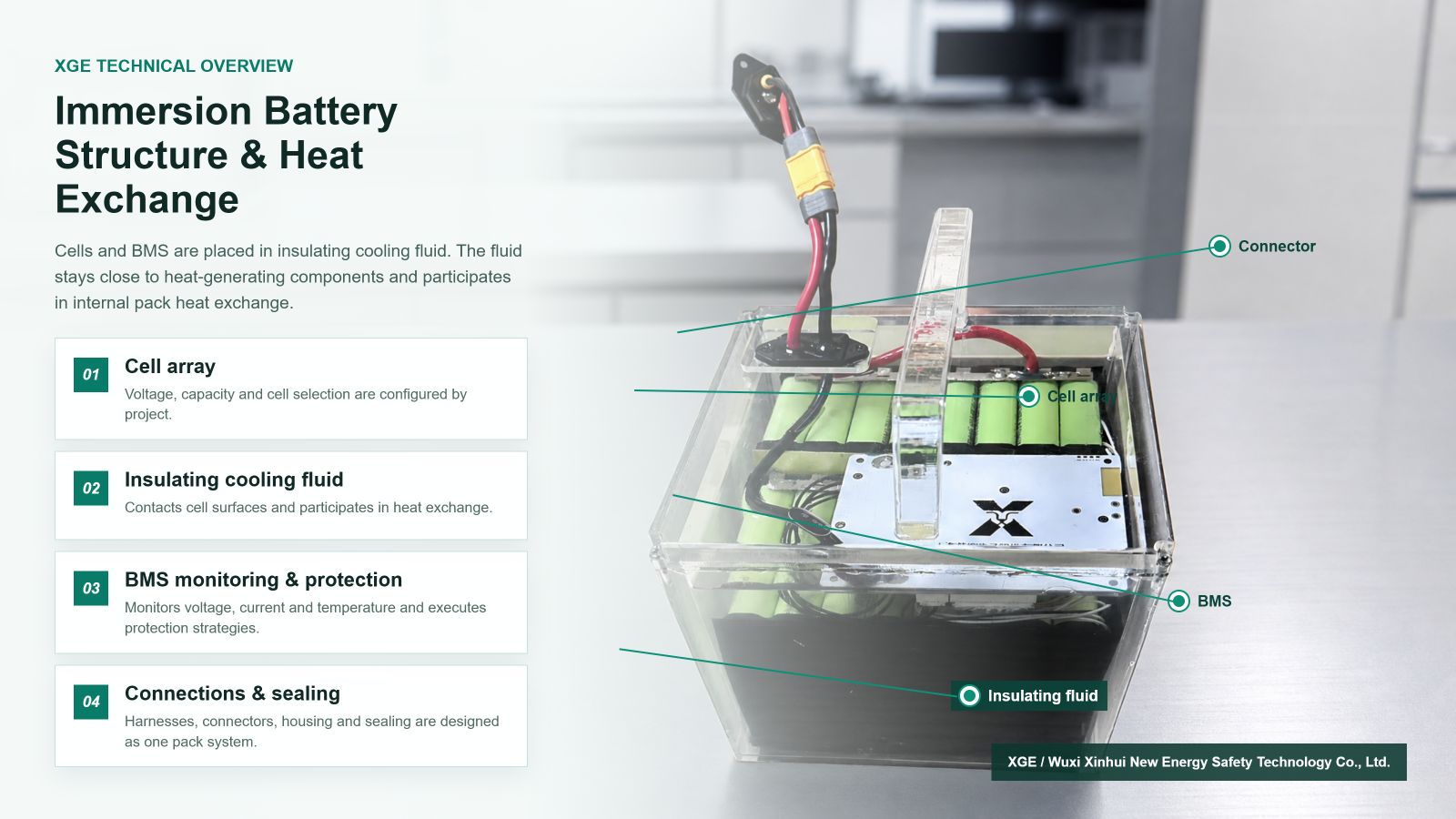
Certification evidence
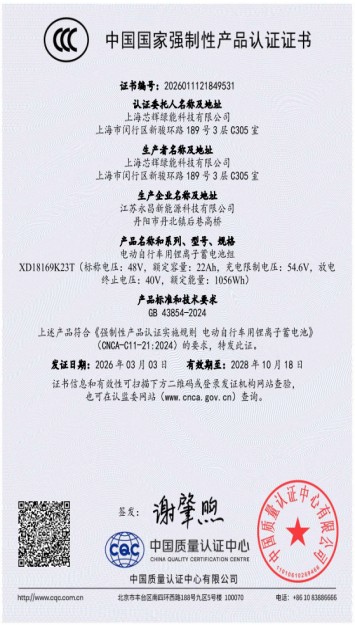
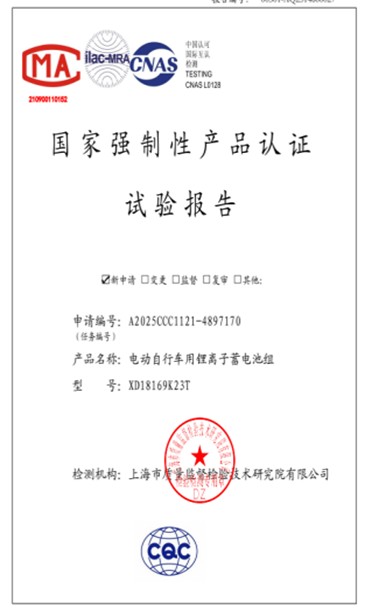
The certificate identifies model XD18169X23T under GB 43854-2024. The certificate holder, manufacturer, specification and applicable scope remain subject to the certificate itself. Other battery series and custom programs require separate certification-scope review.
Technical guides for overseas buyers
These English guides answer common sourcing questions from OEMs, distributors, battery swapping operators, and fleet buyers.
Definition, structure, working principle, and EV application scenarios.
A practical explanation of thermal runaway, thermal propagation, and pack-level safety design.
A procurement checklist for OEMs, distributors, and fleet operators.
Compare thermal management, fast charging, serviceability, weight, and sourcing scenarios.
Understand direct-contact immersion cooling and indirect cold-plate liquid cooling.
Evaluate cells, BMS, temperature rise, connectors, certification, and applications.
Short answers about short circuit, thermal runaway, swapping, 3C charging, certification, and voltage selection.
A buyer guide with inquiry parameters, evidence checklist, and sample validation steps.
Compare standard packs, potting, cold-plate cooling, air cooling, 1C/3C, 48V/60V/72V, and NMC/LFP suitability.
Brochure images, specifications, CCC certificate evidence, test report cover, and sourcing resources.
Why immersion battery packs require insulating fluid and what buyers should verify.
Incoming inspection, cell consistency, BMS, insulation, sealing, capacity, certification, and traceability checklist.
How to evaluate voltage, heat, rain, charging habits, documents, MOQ, samples, and suppliers for Southeast Asia markets.
Cabinet fit, connector, BMS protocol, charging policy, traceability, maintenance, and operator documents.
Charging windows, 1C/3C selection, temperature rise, connectors, cycle life, fleet maintenance, and validation.
Load, range, voltage platform, installation space, BMS, validation, and custom pack development.
Product range, documents, samples, warranty boundary, MOQ, lead time, and channel support materials.
Requirements, specification confirmation, sample build, validation, pilot order, documents, and mass production.
Applications
Choose the closest scenario to review project requirements, validation points, and sourcing recommendations.
48V/60V/72V immersion battery packs for e-bikes, e-motorcycles, distributors, and OEM/ODM programs.
Battery packs for swapping cabinets, centralized charging, BMS communication, and battery ID tracking.
Custom packs for cargo, park logistics, operating fleets, and higher-load EV applications.
1C fast charging and 3C ultra-fast charging battery solutions for delivery and urban operation fleets.
Project Fit
Overseas buyers can evaluate XGE for electric two-wheelers, compact delivery vehicles, swapping cabinets, and private-label programs. A useful technical review starts with operating conditions, pack dimensions, voltage and capacity, connectors, BMS communication, charging rate, target-market documents, and service requirements. The immersion structure is assessed as part of the complete pack and is designed to help reduce thermal propagation risk.
Comparison
Overseas buyers often compare standard lithium packs, potting, cold-plate liquid cooling, and immersion battery packs. This table summarizes the differences for sourcing decisions.
| Item | Standard pack | Potting | Cold-plate liquid cooling | XGE immersion pack |
|---|---|---|---|---|
| Thermal method | Natural or structural conduction | Compound conduction | Indirect heat transfer | Insulating fluid directly contacts cells and BMS |
| Propagation control | Depends on cells, BMS, structure | May help delay propagation | Improves temperature control | Helps absorb heat and reduce propagation risk |
| Fast charging | Limited by temperature rise | Depends on structure | Generally stronger | 1C fast charge and 3C ultra-fast charge designs, subject to validation |
| Applications | Cost-sensitive models | Heavy protection scenarios | Medium/high-power EVs | Two-wheelers, tricycles, swapping, distributors |
Sourcing Inquiry
Provide the vehicle type, voltage and capacity target, pack dimensions, connector, BMS requirements, charging rate, target market, sample quantity, annual volume, and required documents. XGE will use that information to evaluate an existing direction or a custom OEM/ODM program. MOQ, sample lead time, production lead time, and pricing are confirmed after the project requirements are reviewed.
Export inquiry
We will provide an initial recommendation based on your vehicle platform, operating conditions, certification needs, and expected annual volume.