
Buying Guide Technical Guide
How to Choose 1C Fast Charging or 3C Ultra-Fast Charging EV Batteries
Direct Answer
1C fast charging is suitable for projects that need better charging efficiency while balancing cost and cycle life. 3C ultra-fast charging is more suitable for high-frequency operation, swapping, delivery fleets, and premium models. Selection should consider cells, BMS, thermal management, temperature rise, connectors, certification, and after-sales strategy.
Key Takeaways
- 1C is often a balanced fast-charging option.
- 3C requires stronger cells, BMS, connectors, chargers, and thermal management.
- XGE materials indicate 1C fast-charge and 3C ultra-fast-charge directions, subject to project validation.
- Fast-charging projects must evaluate temperature rise, cycle life, and certification scope.
What do 1C and 3C mean?
C-rate describes charge or discharge current relative to battery capacity. In simple terms, 1C is a balanced fast-charging level, while 3C is a much higher-rate charging design that places stronger requirements on cells, BMS, connectors, and thermal management.
1C vs 3C comparison
| Item | 1C fast charging | 3C ultra-fast charging |
|---|---|---|
| Charging speed | Faster while balancing cost and life | Much faster for high-frequency operation |
| Cell requirement | Requires suitable rate capability | Usually requires high-rate or full-tab cell design |
| Thermal requirement | Temperature rise must be controlled | Thermal management pressure is higher |
| Applications | Commuter two-wheelers, distributor models, standard swapping | Delivery fleets, high-frequency swapping, premium models |
Sourcing recommendation
Choose 1C if the project prioritizes stability, cost, and cycle life. Evaluate 3C if the project requires extremely fast replenishment and can support higher system cost and validation requirements.
FAQ
Is 3C suitable for every electric two-wheeler?
No. It requires stronger cells, BMS, connectors, charging equipment, and thermal management.
How do 1C and 3C charging rates affect EV battery sourcing?
A 3C design places higher requirements on cells, BMS, connectors, chargers, and thermal management. A 1C design can be easier to balance against cost, service life, and charging efficiency.
Are fast-charging EV batteries suitable for delivery fleets?
They can be evaluated, but vehicle count, daily mileage, charging windows, temperature rise, cycle life, and maintenance processes must be considered together.
Sources and Content Review
Sources
- Wuxi Xinhui New Energy Safety Technology product brochure and technical materials
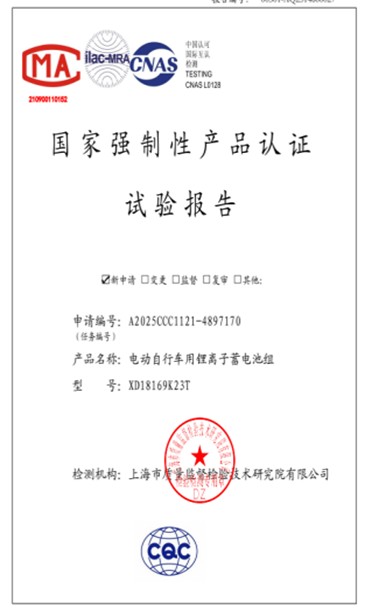
- XD18169X23T CCC certificate
- National compulsory product certification test report cover
- GB 43854-2024 related certification requirements
- Final project specifications are subject to the mutually confirmed specification
Claim, evidence and scope
| Claim | Evidence | Scope |
|---|---|---|
| 1C fast charging is suitable for projects that need better charging efficiency while balancing cost and cycle life. 3C ultra-fast charging is more suitable for high-frequency operation, swapping, delivery fleets, and premium models. Selection should consider cells, BMS, thermal management, temperature rise, connectors, certification, and after-sales strategy. | Product materials and the sources linked above | Subject to project validation and the mutually confirmed specification |
| XD18169X23T certification information | CCC certificate and test report cover | Only the model and scope stated on the certificate |
Content Review
- Product team
- Certification document team
- Last updated: 2026-05-24
Need help choosing 1C or 3C?
Send vehicle type, capacity, daily usage, and charging requirements.
Submit Inquiry