
Safety Technical Guide
How does immersion help reduce thermal runaway propagation risk?
Direct Answer
Immersion lithium battery packs place cells in an insulating fluid environment. The fluid directly contacts cell surfaces, helps remove local heat, improves temperature uniformity, and works with BMS monitoring, pack structure, sealing, and testing to reduce abnormal heat propagation between cells.
Key Takeaways
- Insulating fluid improves heat exchange close to cell surfaces.
- BMS monitors voltage, current, and temperature signals.
- Pack structure, sealing, and venting help manage abnormal events.
- Factory testing and traceability support production consistency.
Thermal runaway vs. thermal propagation
Thermal runaway describes abnormal rapid temperature rise inside a cell. Thermal propagation describes whether heat or other effects spread from one cell to neighboring cells or the whole battery pack.
Important claim boundary
No lithium battery design should be described as completely an absolute safety guarantee, an absolute safety guarantee, or failure-proof. Immersion battery packs should be described as designed to help reduce thermal runaway propagation risk.
FAQ
Does immersion cooling replace BMS?
No. The insulating fluid supports thermal management, while BMS, structure, sealing, testing, and correct use remain necessary.
What does thermal propagation control mean for an EV battery pack supplier?
It means the supplier should explain how cells, BMS, pack structure, insulating fluid, sealing, testing and correct use work together to reduce propagation risk.
Can a China lithium battery supplier claim a pack is an absolute safety guarantee?
No. Professional export wording should avoid an absolute safety guarantee, an absolute safety guarantee or an absolute safety guarantee claims and use designed to help reduce thermal propagation risk instead.
Sources and Content Review
Sources
- Wuxi Xinhui New Energy Safety Technology product brochure and technical materials
- XD18169X23T CCC certificate
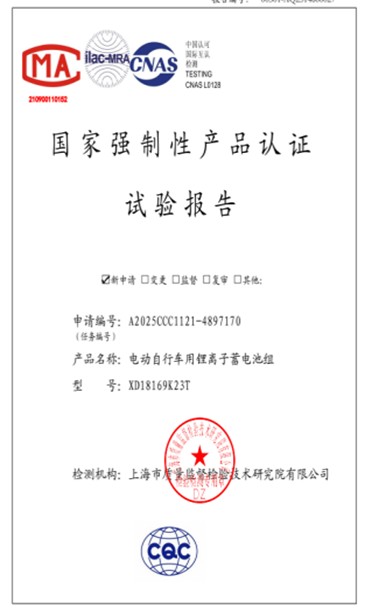
- National compulsory product certification test report cover
- GB 43854-2024 related certification requirements
- Final project specifications are subject to the mutually confirmed specification
Claim, evidence and scope
| Claim | Evidence | Scope |
|---|---|---|
| Immersion lithium battery packs place cells in an insulating fluid environment. The fluid directly contacts cell surfaces, helps remove local heat, improves temperature uniformity, and works with BMS monitoring, pack structure, sealing, and testing to reduce abnormal heat propagation between cells. | Product materials and the sources linked above | Subject to project validation and the mutually confirmed specification |
| XD18169X23T certification information | CCC certificate and test report cover | Only the model and scope stated on the certificate |
Content Review
- Product team
- Certification document team
- Last updated: 2026-05-24
Need a thermal safety review?
Share your vehicle platform and operating conditions for an initial assessment.
Submit Inquiry