Comparison Technical Guide
Immersion Battery vs Potted Battery Pack: Which Fits Your EV Project?
Direct Answer
Immersion battery packs and potted battery packs both aim to improve pack reliability, but they solve different problems. Potting focuses on fixation, vibration resistance, waterproofing, and local insulation. Immersion focuses on direct-contact thermal management and thermal propagation risk reduction.
Key Takeaways
- Potting improves fixation, vibration resistance, waterproofing, and local protection.
- Potted packs can be harder to repair and may add weight.
- Immersion packs use insulating fluid in direct contact with cells and BMS.
- Fast charging, swapping, and centralized charging projects should evaluate immersion packs.
Comparison table
| Item | Potted battery pack | Immersion battery pack |
|---|---|---|
| Main purpose | Fixation, vibration resistance, waterproofing, local insulation | Direct-contact thermal management and propagation risk reduction |
| Thermal method | Compound conduction, affected by material and thickness | Insulating cooling fluid directly contacts cells and BMS |
| Fast charging | Depends on compound and structure | 1C fast charge and 3C ultra-fast charge designs can be evaluated by project |
| Serviceability | Harder to disassemble and repair | Requires fluid, sealing, and maintenance strategy |
| Applications | Waterproof and vibration-heavy standard projects | Fast charging, swapping, centralized charging, safety-focused projects |
Sourcing recommendation
If the project mainly requires waterproofing, vibration resistance, and low-cost structural protection, potting may be suitable. If the project requires fast charging, swapping, centralized charging, or stronger safety differentiation, immersion packs are worth evaluating.
FAQ
Is potting safer than immersion?
Potting improves local protection, but it does not solve every thermal propagation issue. Safety still depends on cells, BMS, structure, and testing.
Which solution is more suitable for fast charging: immersion or potting?
The choice requires project validation. Immersion emphasizes fluid-based heat exchange and temperature balancing, while potting emphasizes fixation, vibration resistance, and local insulation.
Should a swapping-cabinet battery use potting or immersion?
Immersion can be evaluated when charging temperature, maintenance, and propagation risk are priorities. Potting can fit projects focused on lower-cost structural fixation.
Sources and Content Review
Sources
- Wuxi Xinhui New Energy Safety Technology product brochure and technical materials
- XD18169X23T CCC certificate
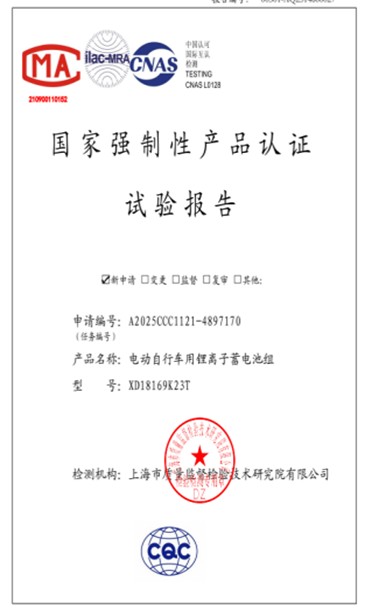
- National compulsory product certification test report cover
- GB 43854-2024 related certification requirements
- Final project specifications are subject to the mutually confirmed specification
Claim, evidence and scope
| Claim | Evidence | Scope |
|---|---|---|
| Immersion battery packs and potted battery packs both aim to improve pack reliability, but they solve different problems. Potting focuses on fixation, vibration resistance, waterproofing, and local insulation. Immersion focuses on direct-contact thermal management and thermal propagation risk reduction. | Product materials and the sources linked above | Subject to project validation and the mutually confirmed specification |
| XD18169X23T certification information | CCC certificate and test report cover | Only the model and scope stated on the certificate |
Content Review
- Product team
- Certification document team
- Last updated: 2026-05-24
Need to compare immersion and potting?
Send vehicle type, voltage, capacity, and use case for a recommendation.
Submit Inquiry