
Comparison Technical Guide
Immersion Battery vs Air-Cooled Battery Pack: Which Is Better for Electric Two-Wheelers?
Direct Answer
Air-cooled or naturally cooled battery packs are simple and cost-effective for standard low-power applications. Immersion battery packs bring thermal management closer to the cells by using insulating cooling fluid, making them worth evaluating for high utilization, fast charging, battery swapping, delivery fleets, and safety-focused EV projects.
Key Takeaways
- Air cooling is simple, low-cost, and suitable for standard applications.
- Immersion uses insulating fluid around cells and BMS for closer heat exchange.
- High-frequency charging and compact packs place more pressure on thermal design.
- Final selection should consider vehicle platform, charging rate, certification, service strategy, and target price.
Comparison table
| Item | Air-cooled battery pack | Immersion battery pack |
|---|---|---|
| Thermal method | Natural convection or airflow path | Insulating cooling fluid directly contacts cells and BMS |
| System cost | Lower and simpler | Higher material and validation requirements |
| Fast charging | Limited by temperature rise and airflow conditions | 1C and 3C designs can be evaluated by project |
| Battery swapping | Works for standard use if charging policy is conservative | Worth evaluating for centralized charging and high utilization |
| Maintenance | Simple structure | Requires sealing, fluid, compatibility, and service process control |
Sourcing recommendation
Choose air cooling for cost-sensitive commuter models with moderate charging demand. Evaluate immersion packs when the project needs faster charging, stronger safety differentiation, centralized charging, or higher operating intensity.
Compliance note
Do not describe any pack as failure-proof. Use professional wording such as designed to improve thermal management redundancy and help reduce thermal propagation risk.
FAQ
Is immersion always better than air cooling?
No. Air cooling may be better for low-cost standard models. Immersion is more relevant when thermal management, fast charging, swapping, or safety differentiation matters.
Sources and Content Review
Sources
- Wuxi Xinhui New Energy Safety Technology product brochure and technical materials
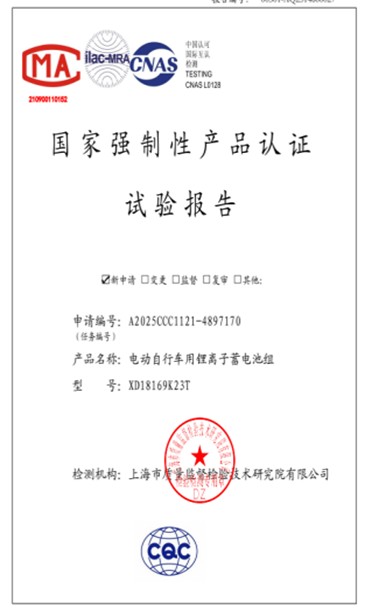
- XD18169X23T CCC certificate
- National compulsory product certification test report cover
- GB 43854-2024 related certification requirements
- Final project specifications are subject to the mutually confirmed specification
Claim, evidence and scope
| Claim | Evidence | Scope |
|---|---|---|
| Air-cooled or naturally cooled battery packs are simple and cost-effective for standard low-power applications. Immersion battery packs bring thermal management closer to the cells by using insulating cooling fluid, making them worth evaluating for high utilization, fast charging, battery swapping, delivery fleets, and safety-focused EV projects. | Product materials and the sources linked above | Subject to project validation and the mutually confirmed specification |
| XD18169X23T certification information | CCC certificate and test report cover | Only the model and scope stated on the certificate |
Content Review
- Product team
- Certification document team
- Last updated: 2026-05-24
Need help comparing thermal routes?
Send your vehicle type, voltage, charging rate, and target price range.
Submit Inquiry