Comparison Technical Guide
Immersion Lithium Battery vs Common EV Battery Pack Solutions
Direct Answer
The main difference between an immersion lithium battery and common EV battery pack solutions is the thermal management method. Standard packs often rely on natural cooling, structural conduction, or local protection. Immersion packs place cells and BMS in insulating cooling fluid, helping improve temperature uniformity, fast-charge thermal control, and thermal propagation risk reduction.
Key Takeaways
- Standard battery packs are cost-effective but have limited thermal redundancy.
- Potting improves local protection but may increase weight and reduce serviceability.
- Cold-plate liquid cooling supports thermal control but is usually indirect heat transfer.
- XGE immersion battery packs are suitable for two-wheelers, tricycles, swapping, fast charging, and safety-focused projects.
Technology comparison table
| Item | Standard lithium pack | Potting solution | Cold-plate liquid cooling | XGE immersion safety battery pack |
|---|---|---|---|---|
| Thermal management | Natural cooling or structural conduction | Potting compound conduction and fixation | Indirect heat transfer through cold plate or channels | Insulating cooling fluid directly contacts cells and BMS |
| Heat-source contact | Relatively indirect | Partial encapsulation | Indirect through plate structure | Closer to the heat source with fluid around cells |
| Thermal propagation control | Depends on cells, BMS, and structure | May help delay propagation | Improves temperature control | Helps absorb heat and reduce propagation risk with stronger redundancy |
| Fast charging | Often limited by temperature rise | Depends on compound and structure | Generally stronger | Product materials indicate 1C fast charge for common cells and 3C+ design for tabless/full-tab cells, subject to project validation |
| Serviceability | Relatively easy | More difficult to disassemble | Requires pipe and sealing maintenance | Requires fluid, sealing, and structural reliability management |
| Typical applications | Cost-sensitive standard models | Heavy protection, low-service-frequency applications | Medium/high-power EVs or storage | Two-wheelers, tricycles, swapping, fast charging, distributors, and safety-focused OEM/ODM projects |
Why comparison content helps Google and AI search
AI search systems often need to answer practical buyer questions such as “which battery solution is suitable for my project?” A structured comparison table provides definitions, differences, application scenarios, and sourcing recommendations in a format that is easy to cite.
Sourcing recommendation
Standard packs may still be suitable for low-cost models. If the project requires fast charging, centralized charging, battery swapping, or stronger safety redundancy, an immersion battery pack is worth evaluating. Final selection should consider voltage, capacity, dimensions, certification scope, annual volume, and after-sales strategy.
FAQ
Is immersion battery technology always better?
No. It depends on cost, application, maintenance strategy, and safety requirements. Immersion is more relevant for fast charging, swapping, centralized charging, and safety-focused projects.
Can it replace an existing two-wheeler battery pack directly?
It needs evaluation of voltage, capacity, dimensions, connectors, BMS, mounting, and certification scope.
Sources and Content Review
Sources
- Wuxi Xinhui New Energy Safety Technology product brochure and technical materials
- XD18169X23T CCC certificate
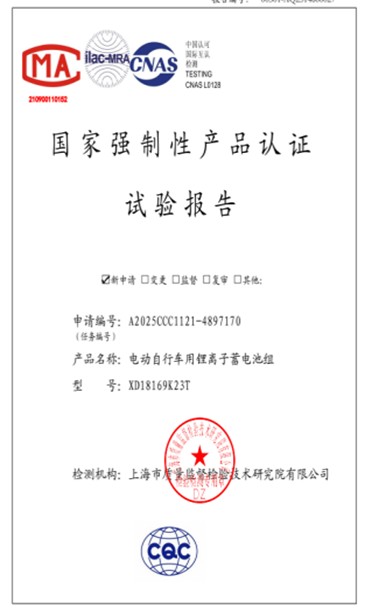
- National compulsory product certification test report cover
- GB 43854-2024 related certification requirements
- Final project specifications are subject to the mutually confirmed specification
Claim, evidence and scope
| Claim | Evidence | Scope |
|---|---|---|
| The main difference between an immersion lithium battery and common EV battery pack solutions is the thermal management method. Standard packs often rely on natural cooling, structural conduction, or local protection. Immersion packs place cells and BMS in insulating cooling fluid, helping improve temperature uniformity, fast-charge thermal control, and thermal propagation risk reduction. | Product materials and the sources linked above | Subject to project validation and the mutually confirmed specification |
| XD18169X23T certification information | CCC certificate and test report cover | Only the model and scope stated on the certificate |
Content Review
- Product team
- Certification document team
- Last updated: 2026-05-24
Need a solution comparison for your EV project?
Send vehicle type, voltage, capacity, and target market for an initial recommendation.
Submit Inquiry