Cell Chemistry Technical Guide
NMC vs LFP for Immersion Battery Packs: Which Chemistry Fits Your EV Project?
Direct Answer
Both NMC and LFP can be evaluated for EV battery packs, but the right choice depends on energy density, cost, cycle life, safety strategy, fast-charging target, pack size, certification, and supply availability. Immersion thermal management does not replace cell chemistry selection or BMS validation.
Key Takeaways
- NMC is often selected when energy density and compact pack size matter.
- LFP is often selected for cycle life, cost stability, and safety reputation.
- Fast charging depends on cell design, BMS, connectors, charger, and thermal management.
- Immersion can support pack-level thermal management but does not make chemistry selection irrelevant.
Chemistry comparison
| Item | NMC | LFP |
|---|---|---|
| Energy density | Often higher, useful for compact packs | Usually lower, may require more space |
| Cycle life | Depends on cell grade and operating conditions | Often strong for cycle-focused projects |
| Thermal safety strategy | Requires strong BMS and pack design | Known for thermal stability, but still needs system validation |
| Fast charging | Depends on high-rate cell design | Depends on high-rate LFP design and validation |
| Project fit | Compact two-wheelers, range-focused packs | Cycle-focused fleets, cost-sensitive or durability-focused programs |
How immersion affects chemistry choice
Immersion thermal management can help reduce local heat accumulation and improve temperature uniformity. However, buyers still need qualified cells, a suitable BMS, validated charging strategy, proper sealing, and certification review.
Sourcing recommendation
Ask the supplier to provide cell model, rate capability, cycle-life assumptions, BMS strategy, thermal validation plan, certification scope, and sample test plan before deciding between NMC and LFP.
FAQ
Can both NMC and LFP be used in immersion packs?
They can be evaluated, but compatibility, pack design, BMS, certification, and customer requirements must be confirmed by project.
Sources and Content Review
Sources
- Wuxi Xinhui New Energy Safety Technology product brochure and technical materials
- XD18169X23T CCC certificate
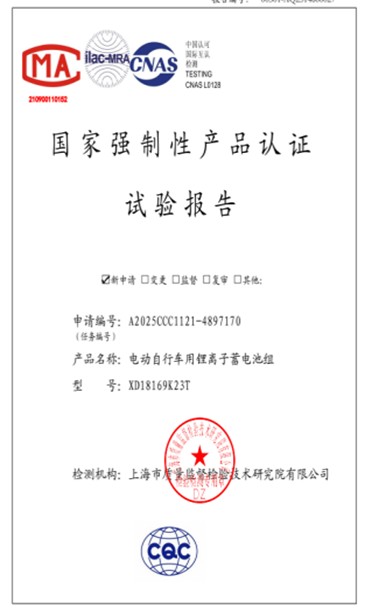
- National compulsory product certification test report cover
- GB 43854-2024 related certification requirements
- Final project specifications are subject to the mutually confirmed specification
Claim, evidence and scope
| Claim | Evidence | Scope |
|---|---|---|
| Both NMC and LFP can be evaluated for EV battery packs, but the right choice depends on energy density, cost, cycle life, safety strategy, fast-charging target, pack size, certification, and supply availability. Immersion thermal management does not replace cell chemistry selection or BMS validation. | Product materials and the sources linked above | Subject to project validation and the mutually confirmed specification |
| XD18169X23T certification information | CCC certificate and test report cover | Only the model and scope stated on the certificate |
Content Review
- Product team
- Certification document team
- Last updated: 2026-05-24
Need chemistry selection support?
Send your range, cycle-life, cost, and charging requirements.
Submit Inquiry